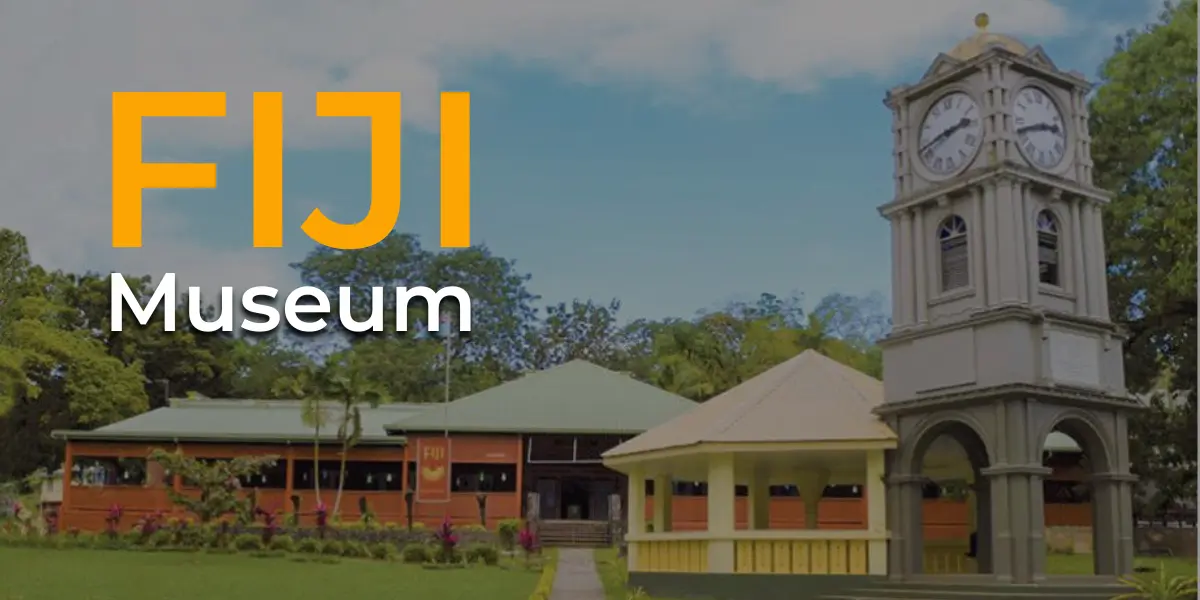
Fiji is commonly being sold as beaches, lagoons, and luxurious resorts paradise but behind these glittering generalities, there is a complex history of indigenous people, colonialism, immigration, and nation-building. Fiji museums are important in enhancing the preservation and interpretation of this complex history. Oral traditions, archaeological evidence, and written records meet in them. To visitors, these institutions offer a background of what is usually lacking in traditional tourism experiences. To students and researchers, they represent entry points into Fiji political, cultural, and social development. The tour of 7 historical Fiji museums is not just an informational process, but it is a chance to learn how identity, power, and resilience have influenced the country. These seven museums and heritage sites are a must visit by anyone who would like to have a more informative insight into the history of Fiji. And yes, this journey can be made far more accessible and flexible when explored at one’s own pace with a reliable local car rental service.
Fiji Museum, Suva
The Fiji Museum is the country’s most authoritative historical institution and the best starting point for understanding Fiji’s past. The museum is situated in Thurston Gardens in Suva and houses collections which date back to over 3,700 years of human habitation. Its archeological display comprises ancient pottery, stone instruments, and remains of ancient Lapita culture, which provide an insight into the earliest inhabitants of Fiji.
The pre-colonial Fijian society is also recorded in the museum in the form of traditional weapons, ceremony objects and sea technology, including full-sized canoes. Their most talked about part is ritual practices and war where it provides a subtle account of the happenings instead of sensational accounts. The period of colonial rule is discussed in detail, as there are exhibits of the British administration, influence of missionaries and the way indigenous government structures were changed.
Beyond artifacts, the Fiji Museum serves as a research and preservation center, supporting cultural heritage initiatives across the islands. For visitors seeking a comprehensive and balanced historical overview, it remains indispensable.
Levuka Historical Port Town Museum
Fiji’s first capital, levuka, provides a rare insight into the colonial history of the country. The town, a UNESCO World Heritage Site, has buildings dating back to the nineteenth century that are evidence of the early settlement of Europeans in the Pacific. The Levuka Historical Port Town Museum is a key factor in putting this environment into perspective.
The museum describes how Levuka developed into an administrative hub of colonial Fiji out of a trading post. Exhibits look into the encounter between the European settlers, missionaries, traders, and the natives. Economic activity and especially the copra trade is studied as one of the things that brought about political change.
What distinguishes Levuka is the way history extends beyond the museum walls. Churches, former government buildings, and old merchant houses remain intact, allowing visitors to experience history spatially. The museum enhances this experience by providing narrative coherence, making Levuka a living archive of Fiji’s colonial transformation.
Museum of the Fijian Armed Forces, Nabua
The Museum of the Fijian Armed Forces, located in Nabua, Suva, focuses on a lesser-known but significant aspect of Fiji’s national identity: its military tradition. The museum documents the evolution of the Republic of Fiji Military Forces from colonial-era units to a modern professional force.
A major emphasis is placed on Fiji’s extensive involvement in United Nations peacekeeping missions. Exhibits include uniforms, medals, operational equipment, and photographs from deployments in the Middle East, Africa, and Asia. These displays highlight Fiji’s disproportionate contribution to international security despite its small size.
The museum also addresses civil-military relations and key moments in Fiji’s political history, offering context rather than glorification. For those interested in strategic studies, defense history, or peacekeeping operations, this museum provides valuable insights into Fiji’s global role.
Tavuni Hill Fort, Sigatoka
Tavuni Hill Fort is one of Fiji’s most important pre-colonial archaeological sites. Situated above the Sigatoka Valley, the fort dates back to the eighteenth century and was constructed by the Tongan chief Maile Latemai. Unlike conventional museums, Tavuni Hill Fort presents history through landscape and structure.
Stone walls, defensive trenches, and elevated lookout points reveal how power and security were organized in pre-colonial Fiji. Informational panels explain regional conflicts, migration patterns, and the influence of Tongan expansion in the islands. The site illustrates how warfare, alliance-building, and geography shaped political authority.
The panoramic view of the valley underscores the strategic logic behind the fort’s location. Tavuni Hill Fort is essential for understanding indigenous governance and military organization before European intervention.
Indian Arrival Gallery, Suva
The Indian Arrival Gallery, located within the Fiji Museum complex, focuses on one of the most transformative chapters in Fiji’s history: the arrival of indentured laborers from British India starting in 1879. This gallery documents the Girmit system, under which thousands of Indians were brought to work on sugar plantations.
Through personal testimonies, photographs, ship records, and official documents, the gallery humanizes a system often discussed only in economic terms. It explores labor conditions, cultural adaptation, and the emergence of Indo-Fijian identity.
The gallery also addresses long-term political and social implications, including demographic change and ethnic relations. By foregrounding lived experience, it offers a critical perspective on colonial labor practices and their enduring legacy in Fiji’s multicultural society.
Sri Siva Subramaniya Swami Temple Cultural Center, Nadi
Although the Sri Siva Subramaniya Swami Temple, located in Nadi, is more of a religious facility, it also serves as a significant cultural as well as historical facility. As the largest Hindu temple in the Southern Hemisphere, it symbolizes the permanence of Indo-Fijian religious life.
The adjacent cultural exhibits explain South Indian traditions, temple architecture, and religious practices brought by indentured laborers and sustained across generations. Murals and iconography narrate Hindu mythology while also reflecting migration and settlement patterns in Fiji.
The site illustrates how cultural continuity was maintained despite displacement and hardship. It offers a very useful insight into the religious aspect of the plural society existing in Fiji and how faith helps to save identity in the colonial and post-colonial circumstances.
Navala Village Cultural Museum
The Navala Village in the Viti Levu (Ba Highlands) is one of the best examples of indigenous Fijian life. The village is also famous because of its traditional bures and strong belief in customary practices. Its local history and social conventions are kept in its cultural museum.
Exhibits revolve around kinship systems, chiefly authority, ceremonial practices and everyday life. As compared to the traditional museums, information is passed on through guided explanations given by the villagers themselves, strengthening the oral tradition.
Navala demonstrates cultural resilience in the face of modernization. For visitors, it provides not only historical understanding but also ethical engagement, emphasizing respect, reciprocity, and community-based heritage preservation.
Conclusion
Fiji’s museums offer far more than historical displays. They provide context, continuity, and clarity about how the nation was shaped by indigenous traditions, colonial interventions, migration, and global engagement. Together, these seven sites present a balanced narrative of power, resilience, and cultural survival. Visiting them transforms Fiji from a scenic destination into a historically grounded society, allowing travelers and researchers alike to engage with the islands in a more informed and meaningful way.